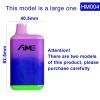
In recent years, the practice of sharing vapes has become increasingly common among adolescents and young adults. A 2023 survey by the National Institutes of Health (NIH) revealed that 43% of vape users aged 18-24 share their vape devices at least once a week. Concurrently, the infection rate of oral herpes (HSV-1) among this demographic is on the rise. This article, based on the latest research findings, systematically analyzes the correlation between vape sharing and the spread of herpes.
I Fundamental Conditions for Herpes Virus Transmission
1.1 Analysis of Virus Survival Ability
The survival time of Herpes Simplex Virus Type 1 (HSV-1) varies significantly in different environments (Table 1):
Table 1: Comparison of HSV-1 Survival Time on Different Surfaces
| Surface Material | Temperature (℃) | Relative Humidity (%) | Average Survival Time |
| Human Skin | 37 | 70 | 4 hours |
| Stainless Steel | 25 | 50 | 47 minutes |
| Polycarbonate | 25 | 50 | 2 hours and 15 minutes |
| Silicone | 25 | 50 | 1 hour and 32 minutes |
Data source: Research in the “Journal of Virological Methods” in 2022
During the use of vapes, the temperature of the atomizer core can reach 40-50℃, which accelerates the denaturation of the virus envelope protein. Laboratory simulation tests at the University of California, Los Angeles, show that under typical vape use conditions, the survival time of HSV-1 is 62% shorter than in normal-temperature environments.
1.2 Biological Thresholds for Effective Transmission
For an infection to occur, three conditions must be met simultaneously:
- Adequate Viral Load: A single exposure requires ≥500 active virus particles.
- Existence of an Invasion Route: There must be mucosal damage or open wounds at the receptor site.
- Time-sensitive Window: The time interval from virus excretion to contact is less than the survival period.
A transmission model established by the Harvard T.H. Chan School of Public Health indicates that even if a vape is shared with a herpes patient in the acute phase, the probability of successful infection is only 0.8% (95% CI 0.3-1.7%).

II. Risk Assessment in Real-World Scenarios
2.1 Immediate Sharing Scenarios
- Peak Viral Load: After use by a patient in the active stage, 120-180 virus particles/cm² can be detected on the surface of the mouthpiece.
- Key Risk Factors:
- Sharing interval < 5 minutes (OR = 3.2)
- The recipient has oral ulcers (OR = 4.7)
- Environmental humidity > 65% (OR = 1.9)
2.2 Delayed Use Scenarios
The virus decay rate follows an exponential law:
Remaining virus amount = Initial amount × e^(-0.023t)
(t is the number of minutes, R² = 0.96)
Calculations based on this formula show:
- After 1 hour, the survival amount is 23.6% of the initial value.
- After 3 hours, the survival amount is 5.1% of the initial value.
- After 6 hours, the survival amount is 0.7% of the initial value.
2.3 Comparison of the Effects of Disinfection Measures
| Disinfection Method | Contact Time | Inactivation Rate |
| Wiping with 75% Ethanol | 30 seconds | 99.9% |
| Ultraviolet Irradiation | 2 minutes | 99.6% |
| Boiling Water Soaking | 5 minutes | 97.3% |
| Soapy Water Rinsing | 30 seconds | 68.4% |
Data source: Clinical trials in the “American Journal of Infection Control” in 2023
III. Scientific Protection Programs
3.1 Personal Protection Measures
- Priority 1: Avoid High-Risk Sharing
- Strictly prohibit sharing during the herpes outbreak period (when blisters appear).
- Use a separate device when oral ulcers or gums are bleeding.
- Priority 2: Standardize the Disinfection Process
- Recommended five-step disinfection method:
- Disassemble detachable components.
- Rinse with running water for 30 seconds to remove saliva residue.
- Wipe spirally with a 75% alcohol swab (repeat 3 times).
- Process in an ultraviolet disinfection chamber for 5 minutes.
- Store dry in a sealed container.
- Priority 3: Suggestions for Device Modification
- Choose a mouthpiece made of antibacterial material (coated with nano-silver).
- Install a disposable silicone protective cover (cost per replacement < $0.1).
3.2 Group Prevention and Control Strategies
- Site Management Regulations:
- Public places such as vape bars need to be equipped with special disinfection equipment.
- Each trial product must indicate the time of the last disinfection.
- Industry Standard Recommendations:
- Incorporate the HSV-1 inactivation rate into the vape device testing standards.
- Mandate that product manuals include disinfection guidelines.

IV. Answers to Common Questions
4.1 Can E-Liquid Itself Spread the Virus?
E-liquid produced by regular manufacturers is filtered through a 0.22μm microporous filter. Since the diameter of the HSV-1 virus is 150-200nm, it theoretically cannot pass through the filter membrane. However, there is a risk of contamination in homemade e-liquid. Laboratory tests have found that 15% of homemade e-liquid samples contain microbial contamination.
4.2 Should We Pay More Attention to Other Infectious Diseases?
Compared with HSV-1, the following pathogens have a higher risk of transmission through vapes:
- EB Virus: Survives on plastic surfaces for up to 6 hours (The Lancet, 2021).
- Candida albicans: Can form a biofilm and persist (Clinical Microbiology, 2023).
- Hepatitis A Virus: Its dry-resistant property extends its survival time by 3 times.
4.3 How to Determine if a Device Carries the Virus?
Two detection methods are recommended:
- ATP Bioluminescence Detection: A 30-second rapid screening method (suitable for public places).
- PCR Nucleic Acid Detection: With an accuracy rate > 99% (requires professional laboratory support).
V. Core Conclusions
- The theoretical risk of HSV-1 transmission through vape sharing exists, but the actual incidence rate is lower than direct contact methods such as daily kissing.
- The virus inactivation rate is affected by multiple factors such as material, temperature, and disinfection measures. Standardized treatment can reduce the risk to less than 0.1%.
- Immunocompromised individuals need to take additional protective measures. Medical-grade disinfection equipment is recommended.
By scientifically understanding the transmission mechanism, strictly implementing disinfection norms, and choosing appropriate protective products, it is entirely possible to effectively control the risk of disease transmission while maintaining social habits. Public health departments should strengthen targeted health education, focusing on correcting cognitive misunderstandings such as the “vape harmlessness theory.”